Sunday, April 29, 2012

SOCIEDAD DE SANSE RIO TEMPESTUOSO


SOCIEDAD DE SANCE
RIO TEMPESTUOSO
 
La 21 Division del Panteon Sancista
de los Siete Jefes
 
SANSE "SANCE" TRADITION


SANCISTA HERMANO BRUJO LUIS


SANCISTA BRUJO LUIS


el Nino Juan
Maria Tormenta &
el Brujo Luis

Maria Tormenta


Ana Maria Roldan
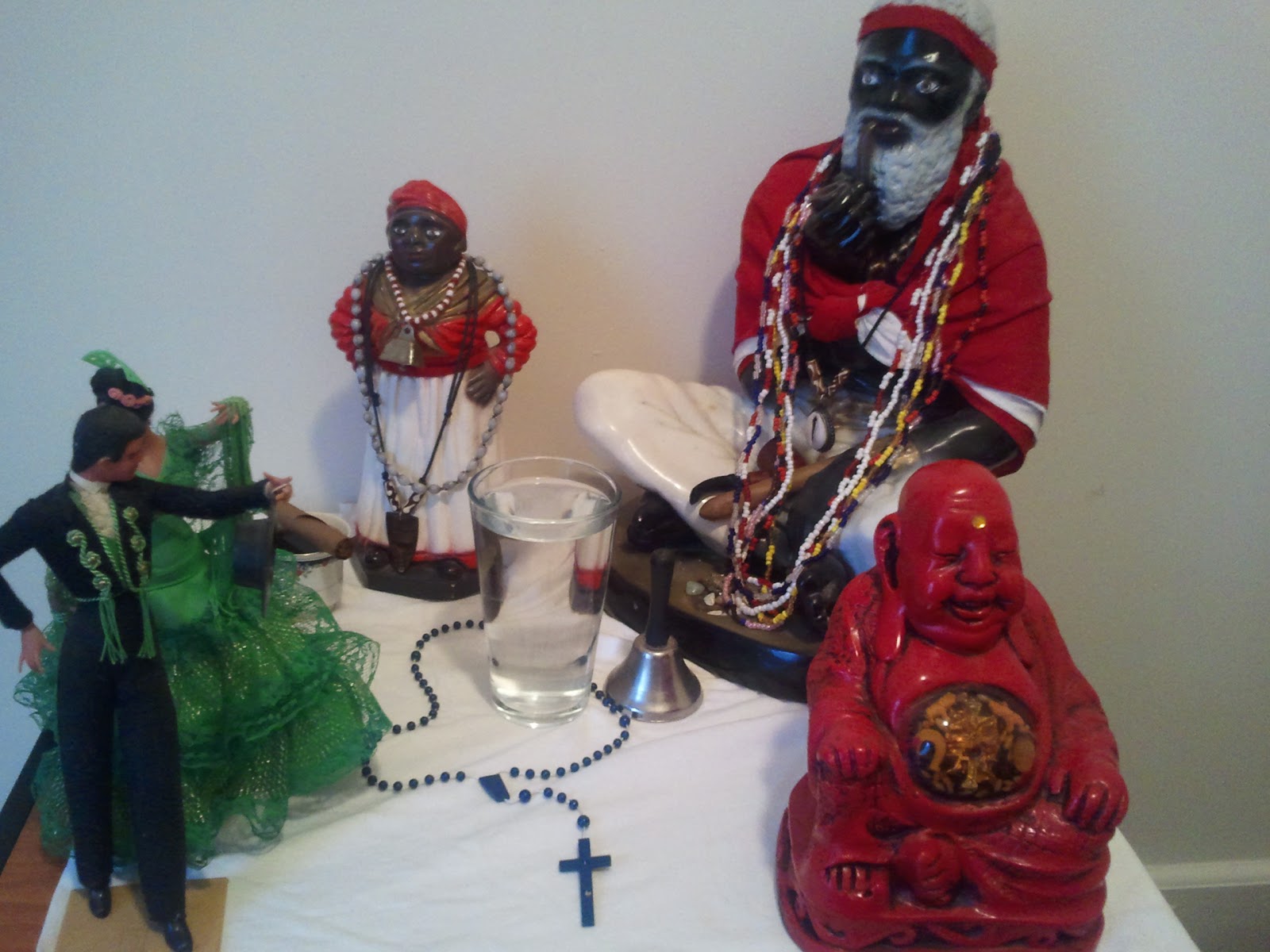
Los Espanoles, La Madama,
Candelo y el Buddha de Ana Maria


FLOR DE JERICHO


TONY "SANCISTA" AYBAR'


TONY "SANCISTA" AYBAR'


IRISH MAN
EL NINO JUAN
SEAN THOMAS NOONAN.
AND YES HE CAN COOK SOME GOOD PUERTO RICAN FOOD
AND SPEAK PUERTO RICAN BORIQUA SPANISH LIKE THE BEST OF THEM


SOCIEDAD DE SANCE RIO TEMPESTUOSO

My Godfather in Sanse is very ill, he has been suffering and battling Alzheimer for a few years and sadly it has been progressing within the last few months and the doctors say he will succumb to it shortly. Although for many this is a sad situation, especially his wife and children. For me it is sad, because I am not onlu going to loose a Spiritual teacher, but also a Father figure. As humans our greed for a physical body is great, I must find strength, faith, and peace in the knowledge of what Sanse teaches. That all though the physical body dies and becomes dust. The Soul, the Spirit lives on.

One day when I was in Puerto Rico, Padrino sat with me and we had a conversation that was of great importance to me.

He said. "Ahijado, when a father has many children, what happens?"

I thought for a moment, thinking to myself it was one of those trick question the old Sabio Puerto Rican men would ask and responded. "I guess it depended on how many he has."

"Ok." Padrino Replied. "Imagine for a moment, a father had 40, 50 maybe 60 small children in one house, what would happen?".

  "I am sure, he would get fustrated.". Was my reply. "This is true.". Replied Padrino. "A man's worth is not measured by how many children he fathers, but by the knowledge and wisdom he bestows upon each and every single one of them, and each one deserves the same attention and teachings.". He stopped for a moment and gazed intently into his Yaucono Coffee, took a sip and then said.

"Mi Ahijado, the same goes for Sanse. You see what self worth does one get having 40, 50, or 60 godchildren, if you can not teach them our ways correctly and properly. Imagine for a moment, you had a son, and he gets into trouble for doing something wrong in society. Who do you think they would blame?".

"The parents.". Was my reply. He smiled and replied. "Exactly, so why would you want to have 40, 50 or even 60 children, if you know that would be an overwhelming task for any one man. What would end up happening is that he would somehow neglect some while teaching others. Or he would naturally favor some. Imagine for a moment how the neglected ones would feel."

  My Padrino before he became ill, once told me. "Soon you will be on your own in physical body, but I will be always be pressent, maybe not in this form, but in Spirit.". Then he said. You will someday teach others, those lessons, although few that I have been able to teach you, you will pass on to those who search for you what I have given you.". Tonight when you lay in bed, place a glass of Holy water with a single bay leaf, under the frame of your bed, where your head rests, this will give you clarify as you dream. Tonight mi Ahijado you will dream. Take note of that which you dream, and when you wake up, first thing in the morning, write down what you dreamt of and let me read it.

  That night I dreamed that I was standing across a river that ran wild, amongst rocks, and wanted to cross to the other side. When I began to cross, the currents where strong and I began to loose balance. The next moment I was being carried buy the waters, and began to panic. Just at the moment when I was to go under, a strong hand lifted me up, and placed me on his shoulders. I was tired but had known that it was a man, who carried me across the river. The next thing I remember, the man lay me on a rock on the other side of the river. When I looked up, I saw the figure of a giant Cacique Taino Indian, but I could not make out his face, as the sun was directly behind him, and overshadowed his facial features. As he slowly tearned to walk away, I said. "Gran Cacique, who are you, what is your name?". He then faced me, and wiith a strong hand pointed in one direction. There I saw the Catholic representation of Saint Christopher carrying the Christ Child across the river. Then disappear. Then the Cacique quietly pointed in the other direction. And there I saw what seamed to be the Greek God, Atlas, crossing the river, with the earth over his shoulder, then disappear. When I went to ask the Cacique, what this ment, I heard the alarm clock beckoning me to awake from my dream.

Latter that day, as Padrino read my dream, he thought quietly for a moment, then replied.

"El Rey Del Agua came to you in a dream mi ahijado, Rio Tempestuoso. He is a Taino Spirit, whose indigenous name has been erased with time and the great genocide of the Taino people. But he comes fortelling, that only through obsticles and great suffering, can one truly learn and overcome. Only through suffering can one truly have compassion for others and understand the paths in life they take.

To my Spiritual God Father Hector Luis Rodriguez,. (Age 61 when he passed)  Que en el Reino de Papa Buen Dios Todopoderoso, siempre estes, y que descanses en paz. This July will be his first anniversary that he has passed into the realm of Spirit.

  I was going to start blogging sooner on Sanse, but my blog was delayed because of his unfortunate passing. On his anniversary I will be posting on him and his life, but want to make it, perfect, in homage of this great man.

My Spiritual Family. Small but strong.

Mi Madrina Mercedes Rivera Rodrigues

Maria Rodriguez. Tia y Sancista

Maria Tormento. (La Prima, Bruja y Espiritista)

Ana Maria Roldan (Ahijada)

Anthony Sancista (Ahijado)

Sean Thoman Noonan (el Compadre)

Joanna Roldan (son to be bautizada, ahijada)

My precious daughters, Yesenia, Chaneliz and Chaceliz, for putting up with my Vudu Brujeria as they call it.

My Mom Olga Iris Rodriguez, for using me as a test when I was a kid for her home remedies and herbal concoctions.

Y Abuelita Juana y Abuelito Colo, k en el Reino de Papa Buen Dios Descansen.


SANSE TRADITION OF PUERTO RICAN 7 DIVICIONES


VOODOO VUDU 7 SIETE DIVICION DIVISION 21 DIVICIONES DIVISIONES PUERTO RICAN LOS SIETE JEFES DEL SANSE, SANCE
SANCISITA HERMANO BRUJO LUIS


Thursday, April 5, 2012

CACHITA TUMBO Puerto Rican Sanse Tradition

CACHITA TUMBO

CACHITA TUMBO

One day in the early summer of June 2006, I was walking through the quaint picturesque New England seaport town of Newburyport.    It had been a year into me being baptized and receiving my first puntos within Sanse and I was returning shortly to receive other ceremonies.  Although I had no spiritual encounters in my mind, just some whale watching and some New England souvenirs shopping for my God Parents, Mother and family members in Puerto Rico.  I had no idea that the spirits, in the form of a photo, would find me.

I had just come off of the whale watching tour, "an experience that I highly recommend every person do once in their lifetime", the adrenaline rush of the experience still had not settled.  Just to be in the presence of these huge magnificent creatures of God and the feeling of how small one is in the scheme of things; next to these enormous docile and beautiful creatures, was one of the most euphoric experiences of my life.  After whale watching, me and the group of friends who accompanied me on this day trip, sat down to grab some lunch.  I remember sitting with them and talking about which whale was the Humpbacks, Minkes or Finbacks, because in all reality we did not have the slightest idea on which was which, or for that matter which species we had seen.  We also spoke of what stores and sights we were to visit in this tourist filled Massachusetts coastal town, when the conversation as it usually does amongst Hispanics took a turn into the world of spirituality, spirits and our spiritual journeys in life. 

On my part of the conversation, I talked of my abuelitos "grandparents" and of my summer visits with them in Puerto Rico and my Espiritismo upbringing.  I spoke of the teachings they instilled within me and how I carried them deep within my heart.  I talked about my Tia and her being the first Sancista in my family.  I talked about how in my mid teens,  I was invited by a school mate to his Godmother's Bembe for Ochun and how a Priestess Santera had become possessed by the Orisha Ochun and how under the influence of Ochun, claimed me as her child and prophesied that she would always be with me and that she would prove it with pruebas that all came true.   I talked about my recieving my collares and Guerrilleros in Cuban Lukumi, my dabbling in American Pagan Witchcraft, my spiritual consultation with a Cuban Palero.  I talked about my "pruebas" as prophesied by Ochun. My spyral down fall into depression and alcohol, and how the Orisha Ochun, my guia Cachita Tumbo and my Muertos led me back into Sanse and Espiritismo.  It was a circle, a cycle I had to undertake to prove my spiritual strength and faculties in overcoming my trials and tribulations of life and coming out confident, wiser and stronger.

After our lunch we decided to do some shopping and visit as many shops and botiques as possible.   As we walked around the many red bricked sidewalks I decided to sit for a moment on a bench and light a cigarette and take a break from the hot June sun under a red maple, tree and I remenber thinking how amazingly beautiful Newburyport must be in October when the leaves of the Red Maple would turn its infamous fiery red and match the red brick buildings and red cobblestone streets of the seaport city.  


Then out of the corner of my eye I saw a thrift store that sold carved wooden canes, that reassembled those used in Cuban Espiritismo Cruzado, and an array of Pagan glass witches balls and wind chimes that could be seen hanging from the window pane. I immediately got up and went in and looked around; not really looking for anything in particular, when I suddenly came upon this exquisite and unique image of the Virgen Mary and Christ Child.   The Madonna was clearly a mulatta or meztisa, not the traditional blue eyed, blond haired, fair skinned Caucasian Virgin of Catholic paintings.  She was dressed in a blue dress that looked as if it were made of blue water with a pink shawl tied to her side, her veil was white with golden embroidery, and around her and the holy child were orange daisies and yellow roses that encircled the crowns she and the child wore upon their heads.  On further inspection of the photo I noticed that the Holy Child within the Virgin's arms and half covered by her vale was dressed in Pink and blue and resembled more a female child then the traditional male child.   I remember thinking.  "Ochun and Cachita Tumbo, and how this may have been how the Africans slaves and the Indigenous people of times long passed must have felt on looking upon Catholic Saints, Angels and Holy Mothers, and envisioning within them their ancient spirits.  I asked the lady how much was the framed photo, as it had to be mine.   She smiled and politely said, that it had belonged to her mother who in life was devoted to this particular Madonna and had brought the image from Italy and that it was not for sale.  I thanked her and asked her, who was this beautiful Virgin on the picture, and how the profile reminded me of Puerto Rico's patroness Our Lady of Providence and Cuba's Our Lady of Charity.  Her reply to me was that it was la Madonna della Neve, her feast day was August 5th and that she was the patron of the village in Italy where her mother was born. 


CACHITA DE LA CARIDAD

Óyeme Cachita, tengo una rumbita pá que tu la bailes como la bailo yo.
Cachita, Cachita Cachita!  Mí pedazo de cielo que Dios me dio.

Many people confuse Cachita Tumbo with the Metresa Anaisa Pye, and although they are very similar Misterios that embody the essence of love, they are not the same.  While it is true that both are Native Spirits, Anaisa Pye, or Anaisa la Chiquita as she is known in Puerto Rico, symbolizes raw sexual energy, and desire.   In the Taino language Anaisa can be broken down to "Ana" meaning Yellow Flower, "I" being that of Spirit,  Nana being a female girl child, Ni being that of water, and Xa pronounced Shah, loving nickname given to daughters.  Many Taino women had the name Ana within their name or Iza as in Yuiza.

Cachita Tumbo is seen as a Petro Loa of fertility, and has also been associated with the Orisha Ochun.  Again they are very similar in that both spirits are of rivers and fresh waters.  But while Ochun is an African Spirit known as an Orisha, brought to the Americas with the slaves, Cachita Tumbo is a Cemi / Zemis Spirit and has her origins in Taino  spirituality that was believed to have been extinct and eradicated.  Which in all reality it transformed for the perpouse of survival.  As many Misterios often do, she can belong to various Division of Spirits.  She is a Metresa as well as a Petro Spirit, and one that falls under the "Indio" Agua Dulce Division.   In her being synchronized with Ochun she falls under the Lokomis Division of Spirits.   (Lukumi)

Cachita Tumbo has her origins in two Taino Zemis, the first being Atabeira the Mother of Fresh Waters and the other being Coatrisquie the Zemi who gathered the fresh waters and made them swell within her womb and created the floods.


Coatrisquie


In the Lukumi tradition popularly known as Santeria, there is a legend that tells how Ochun and Oya are in constant competition and battle over the love of their husband Chango.  This Santeria legend, which is known as an apataki is surprisingly similar to the Taino legend that tells the tale of when the female Zemi of fierce winds Guabancex quarrelled with her messenger Guatauba / Guatava the Zemi of thunder, lightning and rainstorms they would create the Spirit Jurakan. This would unsettle the docile Coatrisquie / Coatrischi , who would fill her rivers with waters and eventually caused havoc on the Natives that built their Bohio "huts" along the riverbank.  In a way this was as if the natural forces of Guatava, Jurakan Guabancex and  Coatrisquie where having a cosmic battle.  Guatava in his rainstorms would be equivalent to the male sperm while the rivers represent  Coatrisquie's womb overflowing with water creating both death and from it rebirth and new life.  Coatrisquie's overflowing would be as that of a woman's amniotic fluid inside her womb.


Atabeira


Atabeira /  Atabeyra / Attabeira /Atabey was translated in Spanish to mean "Madre de las Aguas" or Mother of Waters, and was known by many names.  Some being Apito, Siella, Suimado, Mamona, Guacarapita, Liella, Guimazoa, Iella, and Ieamaye. The latter Ieamaye sounding similar to the Orisha Yemaya and the Yoruba Yemonja, who was originally viewed as a River Deity that resided within the Ogun River and was not associated with the Ocean until the Middle passages of the Slave Trade.  Until then Olokun was viewed as the deity of the depths of the Ocean.  (The Yamaye Taino tribe of Xaymaca "Jamaica" where named after her which they called Atabeira Ieamaye or Atabex .)

Atabeira is the Supreme feminine deity of the Taino people and was worshipped as the progenitor of the life-giving earth God Yúcahu Bagua which was the Lord of Land and Sea.  She was his equal and his feminine counterpart.  She was the Goddess of fertility, motherhood and sexual desires.   Her messengers in Borinquen where the tree frogs Coqui, whose matting call is increased during rainy season.  In the time of the Taino this was an indication and a message from the Zemi to plant their crops, especially that of the cassava/yuca.  It was a time when the earth was fertile, and sexual activities increased because of their confinement to their Bohio in part due because of the heavier rains.   Atabeira and Yucahu are Earth Spirit Gods, and not to be confused with the Cosmic Creator of the universe Yaya, who was never directly worshipped by the Taino.

In Taino Zemi petroglyph "carvings and drawings of the Zemis" Atabeira is often depicted in a squatting position.  This position is symbolic of a women in preparation for sexual intercourse, the position held during childbirth, the position held by women during the release of urine and feces and the position of her messengers the Coqui tree frogs. The first three are symbolic of Atabeira as the creator, of the earth God Yucahu, humans on earth and the sea, which is her urine, and as a sexual deity.


Praise to Attabeira


Bibi Atabey.  Attabeira Yermao Guacar Apito Zuimaco, Atte aya Yocahu Bagua Maorokoti,  Coaiba Mamona, Atte itabo era, Aturo aya wakia Itiba Cahubaba, Ocama Yucayeke Taino Wakia Arawaka, Yermao waka waili, Wakia Yari, Busica Ketauri, Inaru Matum. Busica wakia Ahia Hu De Tai Ku Buya Jan Jan Nabori Daca, Jan Jan Katu.

Mother Atabey oh Great Attabeira Yermao Guacar Apito Zuimaco. Mother of God, Heavenly Mother of the Moon, Mother of Waters, Sister of our Ancient Bleeding Mother.  Hear our Taino People and Protect our Children, Our Precious Jewels.  Give us Life oh Generous Woman. Give us your Blessing, Good Spirit Yes.  I am your servant.  So Be It


Mama Cachita Tumbo

CACHITA TUMBO


Cachita Tumbo embodies both Atabeira and  Coatrisque, and as thus is an enormously powerful Misterio.  She is a lover, a mother, a teacher and the provider of the sweet waters that sustains life on earth.  But as she is a giver of life she is also a destroyer and rebuilder,  she is the energy that can destroy in order to make way for new life. 

Her first name Cachita comes from a few words with Taino origin.  The word Cacica which means female supreme chief and ruler, the Taino word Calichi which means the Fountain from the highest Mountain, and Kachi which means golden ray of light from the Sun.   In Caribbean Creole Spanish Cachita is a broken down word for little one, Chiquita.  (One must understand that the Indigenous people where shorter in stature than the European.)  Also as I stated before Caxi which was a shortened version of the name for Coatrisque.

Tumbo is Spanish for a violent motion of the body, first going in one direction and then to another direction, which is generally caused by a lack of balance.  It can also come from the word, Tumbar which means to tumble, topple or overthrow.  This emphasizes Cachita Tumbo's abilities to cause floods within villages, an occurrence that happens today with rural pueblos near rivers.

Cachita Tumbo can also be felt through her abilities to be a conductor of electric currents.   She is the Misterio that converts fluid flow energy to electric energy.

Cachita Tumbo also works with other Spirits of the Agua Dulce Division such as Padre de Agua or El Rey del Agua, who is also called Agua Dulce, or Baba Yague and is synchronized with Saint John the Baptist.  Without the watchful eye of Padre de Agua, baptisms into Sanse would be almost impossible.  Rio Tempestoso which is synchronized with Saint Christopher and Tindjo Alague which is synchronized with Saint Rafael.

Unlike Santeria in which all the Orisha have their own numbers, in Puerto Rican Sanse the Misterios share the number, 3, 7 and 21.  But each has their own offerings, and like Ochun, Cachita Tumbo enjoys pumpkins, honey, eggs, citrus fruits, Brown sugar, cinnamon, star anise as well as Mangoes,  guavas, guanabana sour sop and quenepas.  She enjoys sweets, perfumes, mirrors, jewelry and fans.  Her colors are amber, yellow, gold, orange, blue and green.   Unlike Anaisa she does not enjoy tobacco, but does like Spiced Rums, champagne, beer, and Anisette liquor.  

Traditionally her image is that of Our Lady of Charity, while others use Our Lady of Divine Providence, and her feast day is celebrated with that of la Caridad del Cobre, which is September 8th.


Oracion a Cachita Tumbo

CACHITA TUMBO

¡Oh Cachita, Cachita Tumbo! ¡Oh Espíritu de la Cacica India, Cachita Tumbo! Gran Metresa Reina Soberana de el amor.  India morena de mi devocion, de piel dorada, canela con miel.  No me desampare de su proteccion, y guia me, de noche y de dia.  En nombre del campo sagrado, del Padre, Hijo, y Espiritu Santo.  Salve Reina Madre Cachita Tumbo.  Ten piedad sobre mi. Gracias y Misericordia Mama Cachita Tumbo.  Jan Jan Katu, Aché y Amen.


Prayer to Cachita Tumbo.


¡Oh Cachita, Cachita Tumbo!  ¡Spirit of the female Indian Chief, Cachita Tumbo!  Great Mistress sovereign queen of love. Indian Spirit of my divotion, she who is of golden skin with cinnamon and honey.  Guide and protect me and do not forsake me, neither night nor day.  In the name of the Sacred Fields of Spirits, and the Father, Son and Holy Ghost.  Praise be Queen Mother Cachita Tumbo.  Show mercy apon me, and for this I shall thank you Mother Cachita Tumbo. So be it, Amen. 


The Concept of Viewing these Spirits
as whores, harlots and prostituetes.

CACHITA DE LA CARIDAD
THE SIBONEY TAINO AND THE AFRICAN SLAVE.

I can not tell you how many followers of African Traditional Religions in the Americas, discredit and have the false concept that the Orisha Ochun, the Misterio Cachita Tumbo is a lady of the night or that the Loa, Anaisa Pye is a Prostitute.  This way of viewing these spirits stems from the repressed mind set of the dominant Christian views that were placed upon us in the Americas. 

Let me explain this by talking about the biblical Mary Magdeline, who was believed to have been a Prostitute.  In all reality there is no mention of her ever being such in any of the biblical versus, she was a woman plagued by seven demons.  Jesus felt pity apon her and casted out these demons from her body.  She was so grateful that she became one of his most beloved disciples and followers.  When the 12 male disciplines, with the exception of John the Beloved abandoned Jesus during his arrest, persecution and crusification, it was she who never left his side.  She was present in the crowd when he was persecuted, was present during his crusification, was one of the women pressent during the burial of Christ, along side Jesus mother Mary, was one of the few that anointed his corpse with perfumed oils, and was one of the first to witness his resurrection. 

Mary Magdeline was incorrectly and falsly believed to have been the same woman, who was to be stoned to death for practicing prostitution on the Holy Sabath day, and her life was saved and spared by Jesus.  She latter anointed Jesus feet with oil and washed them with her tears, kisses and hair.  In all reality this woman by name was never mentioned in the Bible.  The view of anything feminine holding power or great importance was not only discredited within Christian religions but Christianity also placed this belief within African and Native American spirituality.
While both African and Indigenous female spirits are known for being highly sexual entities.  This view has to do with them fertilizing the earth and making it sustainable, and livable for human life on earth. To view them as whores or prostitues, one is literary subjecting oneself to the Spanish Conquistadors mind set of African Woman and Taino woman being less than Perras,"bitches."

Women within indigenous cultures were not oppressed or seen as less than their male counterparts, in fact they were viewed as equals.  Women were the mothers, they could hold titles of Chiefs, could bring forth life, were the medicine woman who understood the wisdom of the healing of herbs.   They were intellegent. had minds of their own, and while men seeked war, the women seeked peace and communal understanding with apposing tribes and the Spanish. They were also fierce warriors and fighters, and the Amazon Rainforest was named after a tribe of warrior native women that resembled that of the Amazons of Greek and Roman mythology.
Every country in the Americas has their version of Pocahontas, Anacaona, Yuiza, Kateri Tekakwitha and Sacagawea who through wit and wisdom played their important roles of both saviors and betrayers of their people's ways which is similar to that of the Egyptian Cleopatra or France's Marie Antoinette.

While the female Orisha and Loases do embody the pleasures of life and sexuality, they are also represented as destructive forces that equal that and are sometimes greater than their male counterparts.  They represent the need for freedom, and self expression, and also the dangers that follow when abusing anything in nature. 

The Loases and Orisha do enjoy sexual activities, dancing, laughter, music and those material things that are viewed by the living, as the finer things in life, they must also be viewed as Spirits of empowerment.  But many initiates wrongly self project their desires and needs for the  inappropriate behavior of touching or fondling others or the excuse for excessive drinking of alcohol and attribute it with that of being under possession of a Loa or Muerto.  I honestly believe that these are not the ways of the Orisha or Loa, but the ways of one's own personal demons which are placed in our presence and paths to overcome and conquer. 

As my Abuelita would say.  "Por cada un Angel que tenemos hay diez Diablos a su rededor".  For each Angel that we have, Ten Devils surround it.


Salve Reina Madre Cachita Tumbo. 
 Ten piedad sobre mi.


SANCISTA BRUJO LUIS


Saturday, March 31, 2012

Differences Between Sanse and Espiritismo

Differences Between Sanse and Espiritismo


What is Sanse. The differences between
Sanse and Espiritismo Criolla.

La Religion es de los Vivos, no de los Muertos."
"Religion is of the living, not of the Dead.'


Let me explain for a moment what Sanse is and is not, and the differences between Sanse and Espiritismo Criollo, also known in Puerto Rico as Espiritismo Folclorico or Espiritismo de la Mesa Blanca. Both are very similar in beliefs and structure, but have many differences.  If they were both the same, why rename a spiritual tradition that has been established, grounded and is a rooted family spiritual belief system? 

Although their are no historical records of when and what family started it, the earliest known accounts of the existence of Sanse on the island have been dated from around the late 1930s to the early 1940s, to a small group of Afro Puerto Rican families that integrated traditional Espiritismo beliefs with that of Puerto Rican Brujeria, Dominican 21 Division and Haitian Vodou.   Some individuals credit the origins of Sanse to a single Papa Boko or Houngan that migrated to Puerto Rico in the 1920s.  This could be so, but it has been historically documented that in 1960 there was an estimated 1,812 Dominicans living on the island, and that Puerto Rico has witnessed an increase in illegal immigration from the Dominican Republic since as early as 1970s.  It is estimated that at present time 200.000 Dominicans live in Puerto Rico.  Haitians also migrated to Puerto Rico as early as 1803 with an increase in 1898.  With groups of Haitians in the coastal towns of Aguadilla, Mayaguez and Juana Diaz.   It has been estimated that around 8.000 Haitians or Puerto Ricans of Haitian descent live in Puerto Rico.  These two minority groups greatly influenced the birth of Puerto Rican Sance, similar to how in the 1950s and 60s Cubans influenced Puerto Rican Espiritismo in New York creating Puerto Rican Santerismo.

Sanse soon became very popular amongst Afro Puerto Ricans on the island,  and in areas of the United States where Puerto Rican people reside.   As many elements of Sanse were added to Espiritista Templos and Centros and its practices has also influenced Puerto Rican Brujeria and Curanderismo. 

While ancestral veneration and trance possession in some form has been a part of Borinquen / Puerto Rico before Christopher Columbus set a foot on Borinquen soil. Much of the foundation of Espiritismo Criollo on the island was heavily influenced with the Taino spiritual and religious culture, that was believed to have been completely eradicated by the Spaniards.  The enormous genocide and atrocities done to the Taino people can not be disputed and has been recorded in historical texts, not only in Puerto Rico but through out the Caribbean, as well as North, Central and South America.   It is also a fact that a few pure blood Taino males did in fact survive and many Spaniards took on Taino woman as wives.  These Taino and other indigenous wives gave birth to the first mestizos, and although many of these Taino women where baptized into Roman Catholicism, under the guise of Christianity they taught their children the lore, customs, traditions and belief systems of their ancestors. 

Espiritismo Criollo also has a mix of French Kardecian Spiritism, and African Yoruba and Congolese religious beliefs.  When the African slaves came into the island, some where brave enough to become fugitives and hid in the caves or rain forests of the island.  These fugitive slaves became known as Cimmarones and while many lived in solitude, some where taken in by the few rogue Taino people who survived and hid themselves as well.   The paring of the two also created the first Zambaggoas, Zambos or Cambujo / Cambujas on the island.  This in conjunction with the mulatto children of slave masters and slaves, were the interracial children that became the first Puerto Riqueños, the first true Jibaro people of the island.  Espiritismo Criollo is a tradition of the people, a Jibaro belief system, just like the infusion of various cultures, it became an infusion of the spiritual traditions which at the time was mainly followed by the poor rural mountain folk. 

One who believes in this spiritual path works with Spirits known as los Seres or los Muertos as well as venerate Catholic Santos, which traditionally where wooden sculptures that resembled the ancient artistry of Taino Zemi sculptures.  Also the belief in various groups of Muertos is observed, these groups are known as Comiciones and can be spirits of people from any country and culture on earth.  In life they could have been atheists, spiritual or religious. They could have been Catholic nuns, the souls of other spiritists, shamans, Cacique Indian Chiefs, African housemaids, Zambaggoas, Cimarrones, Pirates and yes even Buddhists or Hindu.

Now Sanse although it has many similarities to Espiritismo Criollo, is also viewed as a branch of Vudú, and is an infusion of three cultures Puerto Rico, Haiti and the Dominican Republic.   The three cultures blending and intermingling belief systems created Sanse on the island.  For many decades Sanse was an underground subculture that was genetically practiced by Afro Puerto Ricans and was kept hidden and apart from the White Spanish masses.  As many Puerto Ricans were and still are suspicious of Brujeria and feared anything Vudù.  Also one must understand that non Catholic Puerto Ricans where not allowed freedom of religious expression until 1898, when the United States took the island from Spain.

Sanse like Espiritismo incorporates the Comiciones but also work with Muertos known as Los Sances. (Also spelled Sanses). These Sanse in life venerated the African and Indigenous Misterios known also as Loases. The Sanses are generally the mulatto, cimarrones, negros, indios and zambaggoa ancestral spirits of priests, priestesses or followers of African based traditions, as well as Taino indigenous Shamans, known as Bohiques or Buhuithu or even Caciques.

In one's personal Cuadro one can have a Sanse who in life was a Dominican Papa Boko or Puerto Rican Bruja, lets say to the Loa "Misterio" Papa Legba, this spirit will be an embajador of that punto of spirits. Lets also say his name in life was Jose, he will come down representing Legba and have similar characteristics as Legba but still hold on to many characteristics that he displayed in his lifetime. Many times they even use the name of the Misterio they venerated in life and are the Sanse of.  For example, in life Maria venerated (notice I do not use the word Worship) Anaisa or Jose venerated Legba, they will come down using the name Maria Anaisa, Juan Legba or simply Mama Maria, or Papa Juan. In Sanse the Misterios do not take possession of a host in full as does traditions such as Cuban Lukumi, Brazilian Candomble or Haitian Vodou.  In Puerto Rican Sanse, when the Misterios come down, they do not come slithering like surpents, juggling fire or eating glass. They come down quickly in observance, either within a Casilla or their pressence is felt within the centro or templo; then they usher in the Sances that work under them. Similar to the possesion of Pentecostals, with the Holy Spirit, the Misterios energy is very powerful and takes over the Sancistas body in jerking and shaking motions, with heavy breathing which calms down as the Sance is ushered in.  A Spiritual Death and union occurs as the Casilla's mind and bodily function is placed under suspended animation and sleep while the Sance or Muerto takes over the casilla's body. 

The Casilla are also called bancos or caballos.  Usually speaking the Sances are very calm and usually work seated, or in a similar fashion as they worked in life.  Often they speak in the tones or dialects and use phrases of the time and era when they walked the material plane, and incorporate indigenous and African words into their often broken Creollo Spanish.
In possession the Casilla's face, body composure contorts and hand gestures become very profound.  Similar to that of Brazilian Umbanda and Venezuelan 3 Potencias Espiritismo.
Usually the casilla is possesed by Legba, a Guedeh, or their very own Guia who usher in the Sances. (Ones Centinela does not physically possess a person in this manner.)  So lets say a Sance by the name Joaquin comes down and he in life was a Babalocha a Lukumi follower or believer in the Orisha Ochosi, he will come down either as Joaquin Ochosi, Joaquin Chosi or simply el Hermano Joaquin. He will display characteristics of Ochosi but still display many characteristics he had in life. Yes the Sanses of the jerarquía of Orishas can and do participate in Sanse sesiones.

Contrary to popular belief, Sanse is not a religion, it is a magico spiritual set of beliefs, and although it has many traditional structured views on how to perform misas, how one performs bautismos, ceremonies, in what order or what prayers are said for any given situation, has a structure on how misas are held, how one conducts themselves during a sesion, order of various division of Misterios, their likes and dislikes, and the color of clothing worn and tabus. Sance is not bounded by religious dogmas or doctrines as each and every Sociedad although they practice in very similar fashions, can and also does have various elements of differences. The main goal of Sanse as is with Espiritismo is based on the desarollo of ones spiritual faculties on the material plane, and the enlightment of the spirit in the realm of Spirits.


To say that the Sanses 'Ancestors' can only come from a certain Division is absurd. They can be the messengers to any Misterio from any division, as long as that Misterio is the Guia Principal or head punto of your Cuadro Espiritual. Meaning that if your guia is Adogan Piel, Pa Cande, or Anaisa Pye, then your Sanse will work under that punto.. Also it is important to understand that many historical Sanse have become elevated into Misterio status such as Ofelia Balendjo, Amalia Belcan, Rosita Legba, Luis Eleguedesito while others such as the Venezuelean Jose Gregorio have become elevated into a folk saint heroe statues, to name just a few and have become either vueltas / caminos of the Misterio they venerated in life or a separate divinity "Misterio" all together: within the same division, and have their own Sances as well. Many individuals have the misconception and argue that la vuelta of Marta la Dominadora known as Marta La Bruja is an ancient Lwa from Africa, while others say she is a Native Misterio of the Petro (Black) Division, or an indigenous spirit, well last time I checked the name Marta has its origins in Aramaic "Israel or Iraq in origin" and la Bruja is the Spanish word for Witch. What happened with Marta la Bruja is that in life she was or might have been a zambaggoa bruja of Arawaque and African descent and she venerated Marta la Dominadora / Metresa Lubana and her life became a part of the folclore and tradition of Lubana and associated with her, she became a vuelta a camino a sister to Lubana.   (Note, in Puerto Rican Sanse their is a division of Misterios known as las Metresas which although a part of the same division can also be a part of another.  The word Metresa a Creole French word which means Mistress.)

In Sanse we all have a guia espiritual, which is a Misterio, we have a Centinela, a Legba and a Guede, and often our spirits come from that group, but Sancistas are not limited to working or being the casillas to only these Misterios as Sancistas can be the casilla to muertos and Sances that do not make up their cuadro. Especially when doing an investigacion or bautismo for an ahijado or ahijada. Who better to determine your Guia your Sanses, your Cuadro, then your Guia her/himself. Why would my guia, Cachita Tumbo come to a client giving the names to the Sances of Papa Candelo, Gunguna, Madre Sili or Adogan Piel? It makes no sense.

Many people say that either you practice Puerto Rican Sance or you practice Dominican 21 Divicion, and not to mix it, which in all reality we do not. The Sances are Sances and the Misterios are Misterios, or as my abuela would say. "Al Santo, Santo, y al Angel, Angel." As I have stated the Sances are the Muertos or Ancestors that work under the punto of a Misterios.  (Traditionally speaking, candles where used for the dead and the Saints, to give them light so they may find light and elevation, while incense was used for Angels, so that our prayers, thoughts and intentions would reach them.  In present day, candles and incense are used for both.)

If your Guia is Cachita Tumbo, Anaisa Pye or Gran Bwa then your Sances will come down as embassadors of them, they will work under them and often act like them.  Many people say do not mix, but their very words are unethical, because while they say "don't mix, it can be very dangerous" they themselves mix traditions and religions. What Religious philosophy or Spiritual tradition in the world today has not borrowed or taken from another, Sanse is not the first nor will it be the last.  Other practitioners of African based traditions say that when you work with the Orisha/Lwa Oggun you should say, Tres Padre Nuestros, an Ave Maria and a Credo.  Or they use the prayer to San Luis Beltran or other Catholic saints in their practices.  This is as mixing as it can get. "That is like mixing bleach with amonia, but unlike those dangerous ingredients together, in this case they do and will work. To a Roman Catholic's perspective, your damming your soul to an eternal pit of fire and sulfur, while being taunted, poked, and tortured by Demons for all eternity. If this is not dangerous, what is? But in Sance you are, 'Desarollando Espiritualmente.' And yes in Sanse we say our Padre Nuestros our Plagerias del Naufrago, our Ave Marias and Credos while listening to Cuban, Dominican Spiritual music, Taino music or Puerto Rican Bomba, Plena or Salsa music of the 1970s as we pray and call on our Sances who are the embajadores of a certain punto of Misterio.  Why do we do this?  For the simple fact that it works, shows results and as a people we represent all the cultures and blood lines that run through our veins, no matter what religious donomination they followed in life.


Also what good is it of me to play music or pray for that matter in a dialect or language that is unknown or not understood to the people at a Misa or Sesion. In some way the language must be fully understood for it to resonate deep within our very souls, and trigger our subconcious minds. If this was not the case, Roman Catholics would still be saying the Holy Mass in Latin.
In Espiritismo Criollo, the beliefs in Catholic Saints and Angels is a very big part of the tradition. Sanse does not differ as images of Saints,Angels and African deities known as atributos de los santos, adorn the tableau espiritual, similar to Espiritismo, with the exception that within Sanse the Saints and Angels can and often do go by the names of the Loas or Orisha known as Misterios, and many of the Catholic Saints are viewed as Embajadors or mensajero to these very Spirits, not the same but of the same.

Lastly Sanse often deals with folk magic, yerbatero herbalism, curanderismo healing and divination that traditionally are not a part of Espiritismo Criolla.  This folk magico system is closer in nature to Puerto Rican Brujeria than Haitian Vodou. It deals with the making of herbal baths, protective amulets, charm bags, and candle magic.

Both Sanse and Espiritismo do not perform any blood sacrifices.  If a Sancista says he/she offers blood sacrifices its because he/she is also a Houngan, Palero or Babalorisha and have received the proper initiation ceremonies to do so.  But the main goal of the Sanse Sociedad is the elevation of both their cuadro espiritual and themselves, and while offerings of food, liquor, tobacco, candles, and herbs are given to the Comiciones, Sanse, Santos and Misterios, generally speaking blood is not offered within Puerto Rican Sanse.


Sanse and Espiritismo Similar Traits.

1. Both Sanse and Espiritismo are monotheism spiritual tradition and have the belief in one God, the Supreme Intelligence, the creator and cause of all there is, ever was and ever will be.  In Sanse God is often called Papa Dios,  Buen Dios, or El Todo Poderoso, and is not limited to sexual gender or human name.  Although the word Papa which means father is often used to describe God.  Buen Dios is the Cause of all there is in the Universe.   Each individual has their personal take and belief on what is God.

2. Both believe in reincarnation, meaning that the soul of an individual can and will reincarnate within the family bloodline or a different culture altogether.

3. Both believe in the plurality of the worlds.

4. Both believe that communication and interaction between the living and the spirit world is possible and occurs frequently.  Spirits can interact with the living as well as interfere   Also one does not have to be a part of Espiritismo or a Sanse Sociedad for this to happen, it happens regardless of your beliefs or disbeliefs.

5. Both believe in the progression of the Soul and that the Spirit can evolve.  

6. While many view either or as a religion, many view both Sanse and Espiritismo as a spiritual foundation or philosophy.

7. Traditionally speaking those who participate in, Espiritismo Criolla and Sanse do so because it is a family tradition, and ones parents, grandparents, godparents, aunts, uncles and ancestors practiced a form of trance possession and had a belief in the communication and interaction with Spirits and the preservation of the memory of ones Ancestors and descendants.

8. Both Sanse and Espiritismo Criolla were developed with the Puerto Rican cultural experience at the time, and is always progressing, ever evolving and growing.  Both are traditions of the people, and both are not subjected to the philosophies, institution or hierarchy of any one tradition.  Remember both Espiritismo Criollo and Sanse have their primary roots in three cultures, Taino, African and European Spanish.

9. The traditions of both are learned within the home from elder family members, and both are simultaneously practiced with other institutionalized religions, such as Catholicism, Pentecostals, or even African or Indigenous belief systems. 

10. Both believe in the law of Cause and Effect.  "Karma". What you throw into the universe, good or bad, will come back to you like a boomerang.

Wednesday, March 21, 2012

THE NACIONES,THE MISTERIOS, THE ELEMENTS

THE NACIONES,
THE MISTERIOS, THE ELEMENTS


"In Sanse, everyone is born with
a Guia Principal, a Centinela, a Legba and a Guede."


The Misterios in Nature

In Puerto Rican Espiritismo the Santos / Misterios are often venerated and honored within the home altar called la Tableau Espiritual, but within Sanse they are also venerated outdoors in nature.  Those who undertake the various bautismos and refrescos de cavesa within this beautiful spiritual tradition are brought and presented to the various puntos de naturaleza where the energies of the Misterios are present and at their strongest.  Also offerings of food, liquids, tobacco and money are brought to these natural settings. 

The Ocean, every Caribbean Island is surrounded by the lush tropical Carribean sea, and is viewed as a Punto de Naturaleza where many Misterios reside.  Estrella Maris, La Diosa del Mar, Yemaya, La Sirena, Olixi Maya, and Madre de Agua to name a few reside within the depths of the ocean, and their blessings can be felt with the coming and going of the tides. 

In the lush rivers, waterfalls, lagoons, ponds and lakes is where many of the Misterios of the Metresas reside.  Many bautismos and refrescos de cavesas are done in these locations and puntos are recieved here.  Irzili Freda, Cachita Tumbo and Padre de Agua and other Misterios reside here.

The forests, jungles, woodlands and rain forests is where the Nacion of the Ogun reside and are venerated, especially on hills, and mountain peeks, and caves.   While Gran Bwa, Gran Bosque, and Osanjeh's presence can be felt deep within the woods.  The Ogun's energies are usually found on higher grounds.  Mountain peeks if possible is where the highly elevated Misterios are venerated.

Within the cemetery reside the Guedé and is ruled by el Baron de Cementerio, Centella, Gunguna, and Papa Legba as well as many other Misterios.

Indian Ceremonial grounds is where the Cemis energies can be felt.  While Indian burial grounds, are very sacred and highly respected, this is where the energies of ancient and ancestral Caciques, Bohiques, Nitainos and Naboria is felt and offerings are left in these areas. 

Other popular areas are in urban settings such as the market places, crossroads, courthouses, and even hospital grounds, where the energies of many Misterios preside. 


7 NACIONES
7 DIVISIONES


Although there are 21 Divisions both in Dominican Vudù and the Pantheon of Puerto Rican Sanse, 7 Naciones are the most venerated and respected amongst Puerto Ricans.  Within each Nacion their is a Punto Misterio known as el Jefe or La Jefa, but what is apparent is that each of the 7 Jefes come from one of the Naciones that follows. 

(Many of the Misterios are separate entities while others are Vueltas of the same spirit.  Example: popular vueltas for el Baron del Cementerio are, Baron de la Cruz and Baron del Sabado.)


THE LEGBAS

PAPA LEGBA


División de los Legbá is Governed by Papa Legba who is synchronized with Saint Anthony of Padua.

The Legbas Nacion embody the element of earth and fire.  They help in opening pathways, opening doors to other realms, as well as uncrossing and destroying sorcery and black magic. Many of the Legbas are great communicators and help us is relaying messages. 

They enjoy black sweetened coffee, pure cigars, coconut in all its forms, sugar cane, and spiced rum.  The younger Legbas enjoy toys, sweets candies of all kinds, coins and are mischievous by nature, while the older Legbas use walking sticks, bells, prefer bills over coins and are serious and stern by nature.  Their offerings are placed on the floor by an entrance, within a corner of a wall or at the crossroads.  Their colors are Brown, Red and black.  

1) Papa Legba
2) Legba Carifu
3) Legba Isasan
4) Legba Grasimo
5) Legba Coehn
6) Legba Lado
7) Legba Manose
8) Rosita Legba
9) Piti Legba
10) Luis "Sito" Elegba
11) Legba Tibon

12) Eleba Crucero
13) Leggua Encrucijado
14) Legba de las Crucesgba


THE OGÙNES

OGUN BALENDJO


División de los Ogunes is Governed by  Ogun Balendyó who is synchronized with San Santiago and Ogun Badagrí who is synchronized with Saint George.  Within this division presides Osanjeh, Gran Bwá, Rio Tempuestoso "San Cristóbal" and Gran Toro Lisa.  The Prieto Division of spirits also fall within this Nacion as well as other Divisions such as the Guedes, Candells, and Legbas.

The Ogun Nacion embody the element of earth, fire and metal.  They are hard workers, guardians, blacksmiths, soldiers and warriors.  Out of all the Naciones they work the hardest, none stop and can be very fierce and tempermental. 

They enjoy Gin, Aguardiente and Rum.  Black unsweetened coffee often spiced with liquor, and all forms of hot and spicy foods.  Their offerings are placed on the floor or on the grounds in wooded areas.  Their colors are Red, Green and Black.

1) Ogun Balendjo
2) Ogun Baldagri
3) Ogun Batalla
4) Ogun Batala
5) Ogun Guerrero
6) Ogun Farai
7) Ogun Oca
8) Ogun Chango
9) Ogun Panama
10) Ogun Sarabanda
11) Ogun Nagua
12) Ogun Ferayo


THE GUEDÉS

GUEDE


División de los Guedés is governed by el Barón del Cementerio who is synchronized with San Elías, within this division Santa Marta la Dominadora and Santa Marta La Bruja, Baron del Sabado, Baron de la Cruz and Papa Guede Limbo.  Although the Candelo spirits have their own division, they also belong within this division.

The Nacion of the Guedés "Ghede, Gedeh, Gwedeh" embody the element of earth and fire.  This Nacion helps in resolving all sorts of problems.  They help in opening and closing the doors to the realm of the dead.  They can be mischievous and often ruthless tricksters, and if offended, can be very dangerous.  They should never be called on by those who do not completely have wisdom over their misteries as they can unleash evil malevolent spirits as easily as benevolent spirits.  
They enjoy all types of hard liquor, black unsweetened coffee, and black pepper in their foods. Their offerings are left at the entrance to a cemetery or on the oldest tomb. There colors are purple, black, yellow and red.  El Baron and Centella enjoy purple..

1) Papa Guedé Nimbo
2) Guedé Alawe
3) Guedé Carifu
4) Guedé Uhsu
5) Guedé Lhea
6) Guedé Martyin
7) Guedé Dionisio
8) Luisito  Guedé
9)  Guedélia Legcua
10) Guedelina
11) La Baronesa
12) Guedé Brigetté


THE CANDELOS

PAPA CANDELO


The Candelos fall under the División de los Prietos, and within this Nacion one finds countless Misterios, which have their origins both in the Americas as well as Africa. 

The Candelo Nacion embody the element of fire and air, and although they are Guedés they also have their own Nacion / Sociedad / Familia / Division.  They open the pathways for progression, change and evolution.  They are great guardians and swift healers and messengers for Papa Buen Dios.  They work hard for finding a solution and solving all forms of dilemmas.  They are great paleros, and have a great wisdom and knowledge over ancient magic and herbalism.  They also work well in all judicial matters.

They enjoy rum, whisky and red wines, hot chillies and red apples, bread, pure cigars, coconut milk and coconut water.  Their offerings can go on the ancestral altar, the boveda or in elevated tombs, and is always covered with a red cloth.   Their colors are red, black and white.

1) Papa Candelo
2) General Cedife
3) Candelo Fronteh
4) Candelo Farai
5) Candelo Gayo Neh
6) Pa Candeh
7) Candelo Agadùn
8) Candelo Siete Espina
9) Candela Ollah
10) Candelina
11) Candelia Llegua
12) Candelito
13) Candeleria
14) Candelo Boro
15) Candelo el Toro
16) Candelo Milayo


THE BELCANES

BELIE BELCAN

División de los Radá or Blanca is Governed by the Higher Order of Misterios such as Belié Belcán "San Miguel", Asaca Dipié "San José", Damballah "San Patricio", Gran Solier, and other countless Highly elevated Misterios.

Within this Division one finds the Belcan Nacion, which embody the element of Air and Earth,   They fight for justice and peace and are a great defense against demons, evil spirits, occult enemies and black magic.  They are wise, ancient and of a benevolent nature although they are fierce warriors and keep order amongst chaos. 

As an offering they enjoy Rum, red wines, cornmeal, cigars and red and green fruits.  Colors are Red and Green.

1) Belie Belcan
2) Daweh Belcan
3) Chiqui Belier
4) Piti Belie
5) Ataque Belcan
6) Espada Fuerte
7) Belcan Sito
8) Papito Belier
9) Beliercito

THE METRESAS

METRESAS

División de las Metresas is Governed by Metresili "Virgen de la Dolorosa" as well as Anaísa Pié "Santa Ana", Anaisa La Chiquita, "Juana de Arco", Gunguna "Santa Elena", Rosita Legbá "Santa Rosa de Lima", Cachita Tumbo, Candelina, Alaila "la Virgen de la Altagracia", Clementina "La Virgen Milagrosa",  Ofelia Balendjo "La Virgen de las Mercedes", La Señorita "Santa Clara" and other female Misterios.  Although they pertain to their own Division, they can also belong to another.

The Mestresas embody the elements of earth and water.  Although this is one separate Nacion, many of the Misterios within it are a part of other Naciones.  They work in matters of emotions, thoughts and feelings.   They govern over love, womanhood, motherhood, maternity, fertility, beauty and femininity. 

They love sweet wines, mixed drinks, champagne, beer, cigarettes, honey, spices, molasses, and sugar.  They adore chocolates especially within a heart shaped box, tropical and citrus fruits, melons and pumpkins.  They love flowers of all kinds but each Metresa has her own favorite, as well as perfumes, mirrors, cosmetics, jewelry, laced fans, combs and hair brushes. 

Their offerings go on the altar in lavish plates and glasses.   Their colors are Pink, Yellow, Orange and Gold.

1) Madre Sili
2) La Metresa
3) Anaisa Pyé
4) Anaisa Demait
5) Cachita Tumbo
6) Danto Pye
7) Filomena Dantu
8) Esili Freda
9) Sili Danto
10) Canaima La Perla
11) Alaila
12) Filomèz
13) Gunguna

LOS INDIOS

INDIO CACIQUE

Division of the Indio Agua Dulce. This is the Division one finds.  El Rey del Agua, "John the Baptist"  Tindjo Alague / Tin Djo Alagwe "Saint Rafael" and Caciques and Cacicas such as Caonabo Yuisa, Anacaona.  In Sanse, el Rey del Agua watches and supervises over all baptismal ceremonies. 

This Nacios of Misterios make up 1/3 of the Misterios, they are highly venerated within Puerto Rican Sanse and are a very important division of Spirits.  They embody the elements of water and air.

They enjoy Tobacco in all its forms, mabi root bark tea, casava bread, yuca with codfish, cornmeal, and arepa bread.  They are often called Indio de la Paz, Indio Bravo, or Indio Guerrero.  Within this Division fall the spirits of the indiginous people and their elevated Spirits and Zemis.  Their colors are Red, Yellow and Green.

1) Indio Alague
2) Indio Carinoa
3) Pluma Blanca
4) Toro Sentado
5) Indio Aguila Roja
6) Indio Enriquillo
7) India Ciboney
8) India Jihoanya

Paños, Banderas and Candles

The Sances work with various paños, and candles representing the Punto Misterios which have their own traditional colors of banderas and paños that are placed on the altar, usually seven various colors are used as well as seven various colored candles or a seven day candle of seven colors is used.  Each of the colors represent one or more Sanses and Misterio.  Black is rarely used unless combating or battling occult enemies. Seven is usually used for peace and protection while nine is used for ending, and removal.  Some use three candles to represent the three divisions.  Excample:  white or yellow to symbolize the White Division, Red or black to symbolize the black division and blue or green to symbolize the indian division.

Yellow =. The Sances of the Metresas, Solier & Guedés.
White = The Sances of the Belcanes and Solier
Blue = The Sances of La Sirena
Green = The Sances of the Indios Belcanes & Ogunes
Pink = The Sances of the Metresas
Purple = The Sances of the Guedés
Red = The Sances of the Candelos, Ogunes & Legbas
Orange = The Metresas
Brown = Sances of the Legbas
Black can also be used for the Sances of the Legbas, Guedés, The Ogun, and Candelos


VODOU, VOODOO, SANSE, SANCE, VUDU, UMBANDA, BRUJERIA, ESPIRITISMO