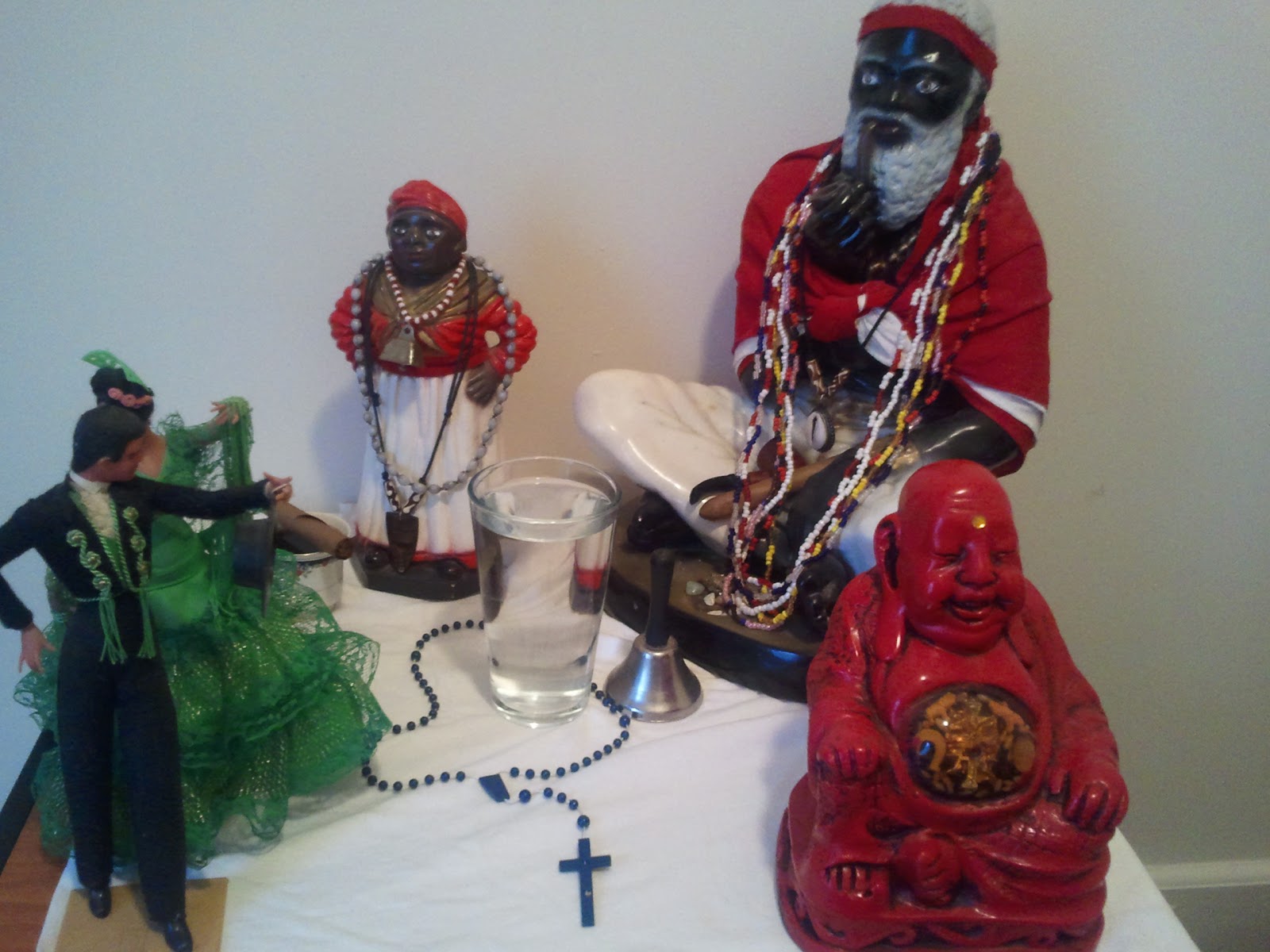
The Mistsrio Naciones and Santos

7 Divisiones of the Puerto Rican
Sanse Tradition

GRAN SOLEY
1. Division Del Cementerio
2. Division de Lebanes
3. Division Soley
4. Division Indio Agua Dulce
5. Division Metresas
6. Division Del Fuego
7. Division Belcanes
Other societies of Sance use this order.
1. Division Solier
2. Division Belcanes
3. Division Candelo
4. Division Metresas
5. Division Lebanes
6. Division Indios Agua Dulce
7. Division de Guede
Still other Sanse Societies use these Divisions.
1. Division Leguas "Lebanes"
2. Division Ogunes
3. Division Guedes
4. Division Candelos
5. Division Belcanes
6. Division Metresas
7. Division Indio Agua Dulce
These orders of Divisions does not make one correct over the other, as each Sance society may have their differences, there are many elements that are the same. What is important to understand is that the Divisions will take on an individual, and no two persons has the same Misterios, as each of the Divisiones has traditionally 7 vueltas, and each Division has their own Emisarios "Sance". In my Sociedad we use the last list. But often times the Jemelos "Marassa call an individual into services and every Sancista works under the guidance of las Tres Maria.". Maria Fe, Maria Esperanza y Maria Caridad.
Important to understand, is that although the majority or practitioners of Puerto Rican Sanse recieve the Puntos to Seven Divisions, "me included". It is not unheard of that a Misterio of a different Division will call on an individual, which can only be determined through a proper Investogacion by a Sancista, and although the "Lua" Misterio may be of a different Division, it is important to understand that a Misterio can be a part of multiple Divisions which will fall on one of the above Divisions.
One can only recieve Bautismos and Puntos into Sanse by a Sancista, just as one can only receive Ocha by a Lukumi priest or any other African or Indigenous Traditions. Unlike some European traditions which have self initiation rites, this concept does not exist in any shape or form within these traditions. Sance as is Santeria, Palo Mayombe, Candomble, Obeah, Shango, Umbanda, Quimbanda, Regla Arara, Dominican 21 Division, Vodou, Santerismo, Winti, 3 Potencia Maria Lionza, Kumina, Spiritual Baptists, Regla Abakua, and Orisa are not solitary traditions, but family oriented and group traditions.
The Seven Divisions or 7 Diviciones are also called, los Siete 7 Jefes and no matter if a seperate Division calls on an individual, he/she will receive the Puntos to Seven Divisions. Although there are 21 Divisions of Spirits, within Sanse only Seven are received. I have posted a few times the Puerto Rican 21 Divisions and I will again include the list.
The Legba "Lebanes'
The Ogunes
The Guede
The Candelos
The Belcanes
The Metresas
The Indios
The Solieres
The Prietos
The Simbises
The Centinelas
The Guineas
The Madamas
The Niños
The Orientales
The Potencias
The Magos
The Aguases
The Jemelos
The Cemises
The Arabeses
THE LEGBAS
División de los Legbá is Governed by Papa Legba who is synchronized with Saint Anthony of Padua.
The Legbas Nacion embody the element of earth and fire. They help in opening pathways, opening doors to other realms, as well as uncrossing and destroying sorcery and black magic. Many of the Legbas are great communicators and help us is relaying messages.
They enjoy black sweetened coffee, pure cigars, coconut in all its forms, sugar cane, and spiced rum. The younger Legbas enjoy toys, sweets candies of all kinds, coins and are mischievous by nature, while the older Legbas use cains, walking sticks, bells, prefer bills over coins and are serious and stern by nature. Their offerings are placed on the floor by an entrance, within a corner of a wall or at the crossroads. Their colors are Brown, Red and black.

1) Papa Legba = San Antonio - June 13

2) Legba Carifu = San Lazaro - December 17

3) Legba Isasan = San Pedro - June 29

4 Luis "Sito" Elegba = Niño de Atocha - January 1

5) Legba Coehn = Niño Cautivo / Nino de Cebu - April 21

6) Legba Lado = Niño de Praga - 3rd Sunday of May

7) Legba Tibon = Niño Pa - April 30th

8) Rosita Legba = Saint Rose of Lima - August 23

9) Piti Legba = Divino Nino - December 25

10) Legba Grasimo = Niño de las Suertes - December 25

11) Legba Manose = Anima Sola - November 2
THE OGÙNES
The Ogun Nacion embody the element of earth, fire and metal. They are hard workers, guardians, blacksmiths, soldiers and warriors. Out of all the Naciones they work the hardest, none stop and can be very fierce and temperamental.
They enjoy Gin, Aguardiente and Rum. Black unsweetened coffee often spiced with liquor, and all forms of hot and spicy foods. Their offerings are placed on the floor or on the grounds in wooded areas. Their colors are Red, Green Blue and Black.

1) Ogun Balendjo = San Santiago Apostal - July 25th , Santiago Matamoro.

2) Ogun Baldagri = San Jorge - April 23

3) Ogun Batala = San Martin Caballero - November 11

4) Ogun Guerrero = Saint Joseph the Worker - March 19

5) Ogun Feregai = Saint Pancracio - May 12

6) Ogun Oca = San Isidore the Laborer - May 15

7) Ogun Sango = San Miguel con Lanza - December 4

8) Ogun Panama = San Wenceslao - September 28

9) Ogun Sarabanda = Saint Pedro Pescador - June 29

10) Ogun Nagua = Saint Mercurius - July 25

11) Ogun Ferayo Jan Ferro = Saint Marcos Evangelist - April 25

13) Ogun Osanje = Saint Francisco of Asisi - October 4
THE GUEDÉS
División de los Guedés is governed by el Barón del Cementerio who is synchronized with San Elías.
The Nacion of the Guedés "Ghede, Gedeh, Gwedeh" embody the element of earth and fire. This Nacion helps in resolving all sorts of problems. They help in opening and closing the doors to the realm of the dead. They can be mischievous and often ruthless tricksters, and if offended, can be very dangerous. They should never be called on by those who do not completely have wisdom over their misteries as they can unleash evil malevolent spirits as easily as benevolent spirits.
They enjoy all types of hard liquor, black unsweetened coffee, and black pepper in their foods. Their offerings are left at the entrance to a cemetery or on the oldest tomb. There colors are purple, black, yellow and red. El Baron and La Baronesa enjoy purple..

1) Baron del Cementerio = San Elija - April 17 or July 20

2) Baron de la Cruz / Baron del Sabado = Saint Gerard Majella - October 16

3) Papa Guedé Nimbo / Limbo = San Expedito - April 19th

4) Guedé Alawe = St Jerome - September 30

5) Guedé Carifu = San Cipriano - September 16

6) Guedé Uhsu = San Luis Beltran - October 9

7) Guedé Lhea = San Alejo - July 17

8) Guedé Martyin = San Martin de Porres - November 11

9) Guedé Dionisio = St Jerome - September 30

10) Luisito Guedé = Nino de Atocha - December 25

11) Guedélia Legcua = Santa Teresa de Jesus - October 15

12) Guedelina = Santa Rita - May 22

13) La Baronesa = Santa Lucia - December 13

14) Ghuede Gran Bwa = Saint Jude - October 28

15) Filomena Lubana = Saint Martha - July 29

16) Bakúlu Baká = Saint Philip / Saint Gabriele - November 14

17) Guedelia = Santa Catelina
 GUEDELIA

THE CANDELOS
The Candelos fall under the División de los Prietos, and within this Nacion one finds countless Misterios, which have their origins both in the Americas as well as Africa.
The Candelo Nacion embody the element of fire and air, and although they are Guedés they also have their own Nacion / Sociedad / Familia / Division. They open the pathways for progression, change and evolution. They are great guardians and swift healers and messengers for Papa Buen Dios. They work hard for finding a solution and solving all forms of dilemmas. They are great paleros, and have a great wisdom and knowledge over ancient magic and herbalism. They also work well in all judicial matters.
They enjoy rum, whisky and red wines, hot chillies and red apples, bread, pure cigars, coconut milk and coconut water. Their offerings can go on the ancestral altar, the boveda or in elevated tombs, and is always covered with a red cloth. Their colors are red, black and white.

1) Papa Candelo = Papa Candelo - November 4

2) General Candelo Cedife = Saint Charles Borromeo - November 4

3) Candelo del Monte / Candelo de la Escoba = Saint Martin de Porres - November 3

4) Candelo Fronteh = Saint Moses the Black - August 28

5) Candelo Farai = San Benito de Palermo - August 28

6) Candelo Gayo Neh = San Baltazar - January 8
7) Pa Candeh = Candelo with White Pants
8) Candelo Agadùn = Justo Juez Negro - Easter Sunday
9) Candelo Siete Espina = Jesus Negro - December 8

10) Candela Ollah = Saint Barbara Africana - December 4

11) Candelia Llegua = Nuestra Señora de los Desanparados - April 27

12) Candelito = Niño Divino - December 25

13) Candeleria = Senora de la Candelaria - Febuary 2

14) Candelo Boro = Saint Charles Borromeo - November 4
The Belcanes

División de los Radá or Blanca is Governed by the Higher Order of Misterios such as Belié Belcán "San Miguel", Asaca Dipié "San José", Damballah "San Patricio", Gran Solier, and other countless Highly elevated Misterios.
Within this Division one finds the Belcan Nacion, which embody the element of Air and Earth, They fight for justice and peace and are a great defense against demons, evil spirits, occult enemies and black magic. They are wise, ancient and of a benevolent nature although they are fierce warriors and keep order amongst chaos.
As an offering they enjoy Rum, red wines, cornmeal, cigars and red and green fruits. Colors are Red and Green.
September 29th
1) Belie Belcan = San Miguel Arcangel - Sept 29
2) Amalia Belcan
3) Daweh Belcan
4) Chiqui Belier =
5) Piti Belie
6) Ataque Belcan
7) Espada Fuerte
8) Belcan Sito
9) Papito Belier
10) Beliercito
11)
The Metresas
The Mestresas embody the elements of earth and water. Although this is one seperate Nacion, many of the Misterios within it are a part of other Naciones. They work in matters of emotioms, thoughts and feelings. They govern over love, womanhood, motherhood, maternity, fertility, beauty and femininity.
They love sweet wines, mixed drinks, champagne, beer, cigarettes, honey, spices, molases, and sugar. They adore chocolates especially within a heart shaped box, tropical and citrus fruits, melons and pumpkins. They love flowers of all kinds but each Metresa has her own favorite, as well as perfumes, mirrors, cosmetics, jewelry, laced fans, combs and hair brushes. Their offerings go on the altar in lavish plates and glasses. Their colors are Pink, Yellow, Orange and Gold.

1) Madre Sili / Metresili = Lady of Sorrows - September 15

2) La Metresa Mama Mambo = Saint Anne - July 26th

3) Anaisa Pyé = Young Mary with Saint Anna - July 26th

4) Anaisa = Jean Dearc - May 30

5) Cachita Tumbo = Our Lady of Charity - Sept 8
Patrona de Cuba
Patrona de Cuba

6) La Sirena = Estrella Maris - September 7

7) Esili Freda = Mater Dolorosa - September 15


9) Ezoli Alaila = La Altagracia - January 21
Patrona de Santo Domingo

10) Filomèz = Saint Philomena - August 11

11) Gunguna Balenyo = Saint Ellen September 14 / May 21

12) Madre de Agua Atabeira = La Divina Providencia. - November 19
Patrona de Puerto Rico

12) La Clementina = La Milegrosa, - November 27

13) Ezili Kénwa = Saint Martha - July 29

14) La Señorita = Saint Claire - August 11

15) Ofelia Balendjo is Our Lady of Mercy - September 24

16) Amalia Belcan / Mama Tete = La Milegrosa - November 27

17 Ayida Guedo = Virgen Milagrosa - November 27
Los Indios

Division of the Indio Agua Dulce. This is the Division one finds. El Rey del Agua, "John the Baptist" Tindjo Alague / Tin Djo Alagwe "Saint Rafael" and Caciques and Cacicas such as Caonabo Yuisa, Anacaona. In Sanse, el Rey del Agua watches and supervises over all baptismal ceremonies.
This Nacios of Misterios make up 1/3 of the Misterios, they are highly venerated within Puerto Rican Sanse and are a very important division of Spirits. They embody the elements of water and air.
They enjoy Tobacco in all its forms, mabi root bark tea, casava bread, yuca with codfish, cornmeal, and arepa bread. They are often called Indio de la Paz, Indio Bravo, or Indio Guerrero. Within this Division fall the spirits of the indiginous people and their elevated Spirits and Zemis. Their colors are Red, Yellow and Green.

TAINA CACICA
Feast Day of all Indios fourth Friday in September and October 12
1) Indio Alague = San Juan Baurista / San Rafael
2) Indio Carinoa = Rey del Agua
3) Pluma Blanca = Indio de la Paz
4) Gran Toro Sentado / Cacique Sentado = Jesus de la Buena Esperanza
5) Indio Aguila Roja = Indio Guerrero
6) Indio Enriquillo = Indio Bravo
7) India Ciboney = Kateri Tekakwitha
8) India Jihoanya = Kateri Tekakwitha

PADRE DE AGUA = JUAN BAUTISTA

RIO TEMPESTOSO
Other Misterios includes Gran Solier, Los Jemelos, and Las Tres Marias.
Gran Solier = Ecce Homo
los Jemelos = San Cosmas y Damian
Las Tres Marias = Faith, Hope and Charity.
Gran Kali = Saint Gabriel
and countless other LUA Misterios


EL BRUJO LUIS
VODOU, VOODOO, SANCE, SANSE, 21 DIVISIONS, RELIGION, VUDU,